

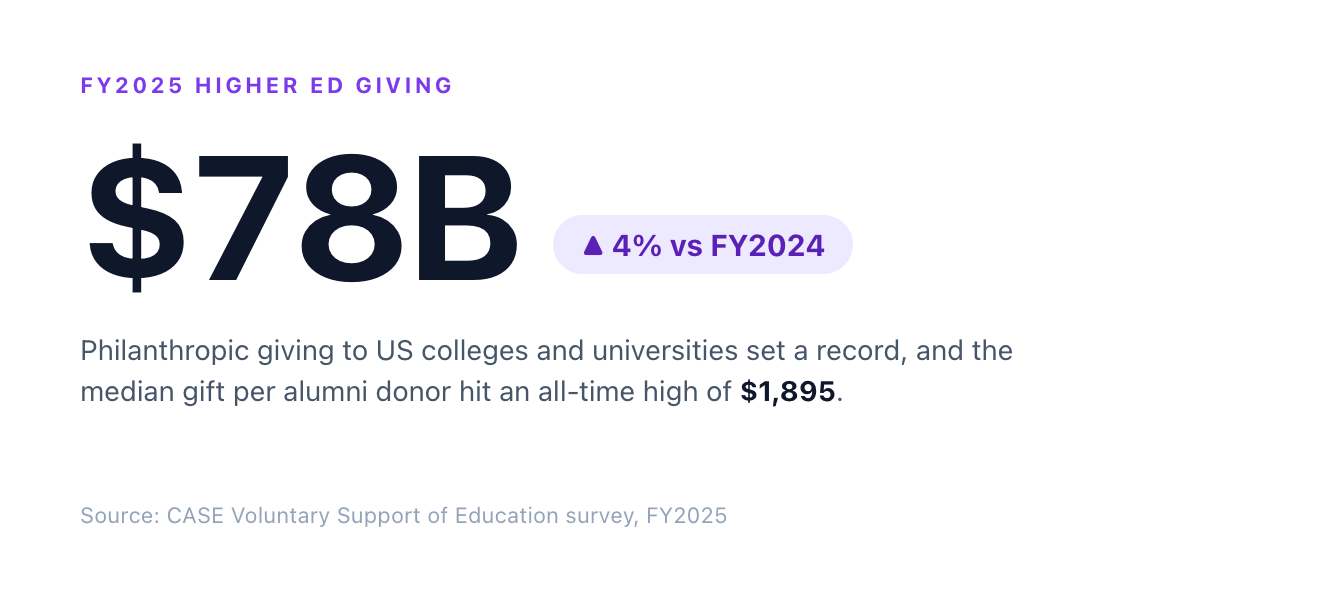
By the headline numbers, FY2025 was a banner year for higher education fundraising. Philanthropic gifts to US colleges and universities totaled $78 billion, up 4% from the year before, according to CASE’s annual Voluntary Support of Education survey.
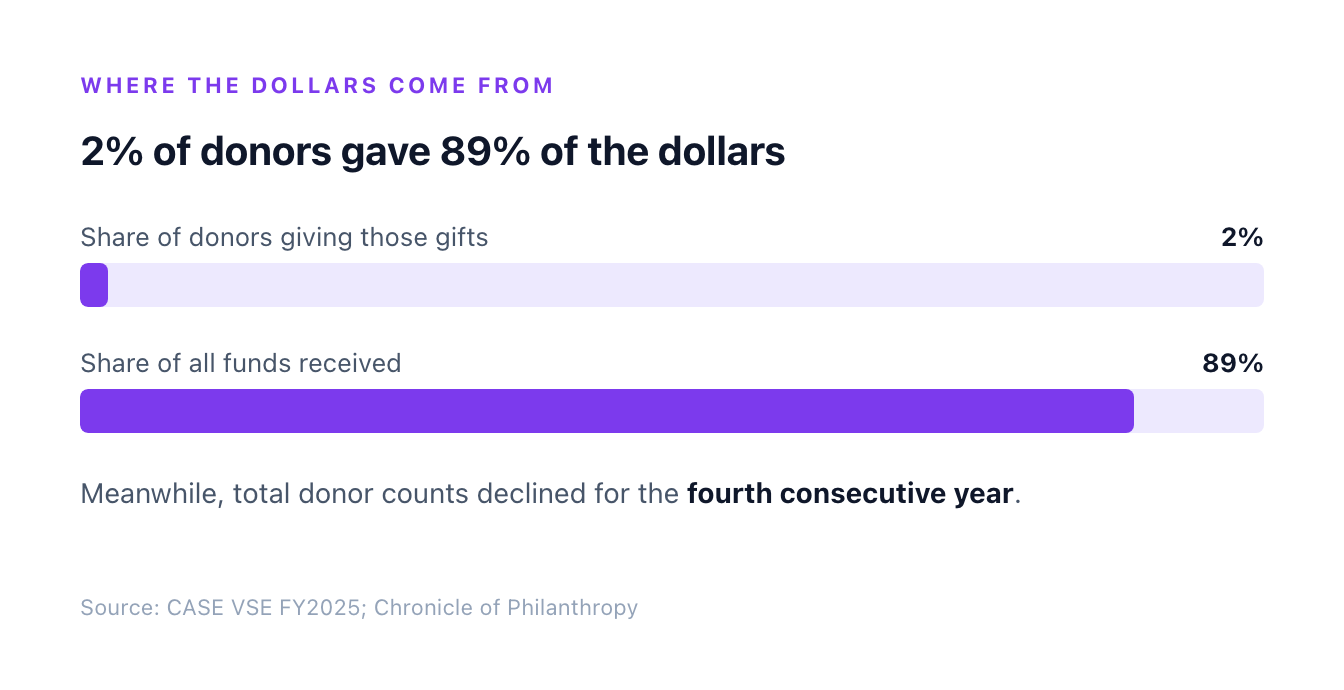
Underneath that record, however, is a trend worth watching closely: the total number of donors declined for the fourth consecutive year. CASE calls it the “donors down, dollars up” trend. Fewer people are giving, and the people who still give are giving more. The median gift per alumni donor hit a record $1,895, and 89% of all funds received came from just 2% of donors.
Why does a shrinking donor base matter?
CASE’s own read is blunt: institutions are increasingly relying on a narrower, higher-capacity donor base to sustain philanthropic revenue. And the donors disappearing from the rolls are predominantly smaller-dollar givers, younger graduates and mid-career alumni whose participation continues to erode year after year.
Concentration at this level changes the risk profile of the entire fundraising operation. When 2% of donors carry 89% of revenue, the annual number is hostage to a handful of relationships. One delayed campaign commitment, one estate gift that closes a year late, one mega-donor who quietly lapses, and a strong year can quickly turn into a difficult one.
Every advancement office knows the feeling of a fiscal year made or broken by two or three gifts. The FY2025 numbers suggest that experience is now common across the sector.
What happens when the donor pipeline hollows out from the bottom?
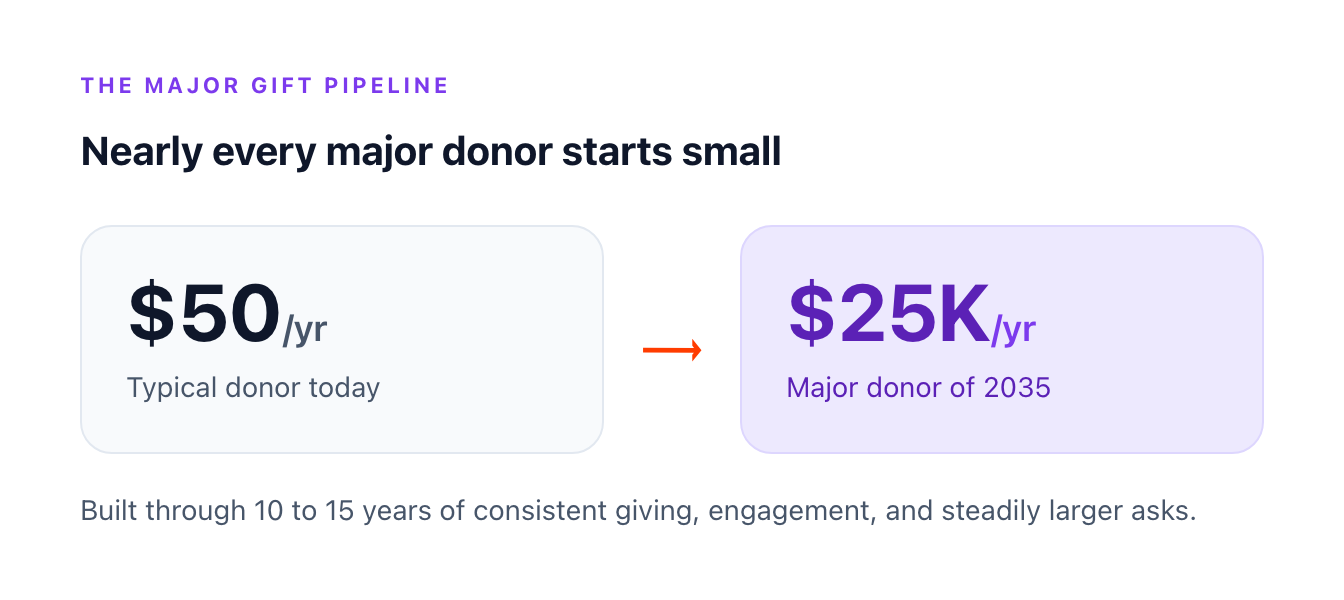
The deeper problem is where next decade’s total comes from. Nearly every major donor starts as a small one. The $25,000-a-year donor of 2035 is, in most cases, a $50-a-year donor today, cultivated through years of consistent giving, engagement, and steadily larger asks.
When participation erodes among younger graduates and mid-career alumni, nothing bad happens this fiscal year. The damage shows up ten to fifteen years later, when the major gift pipeline that was supposed to replace today’s aging top donors simply is not there.
Why is proactive donor cultivation so hard to staff?
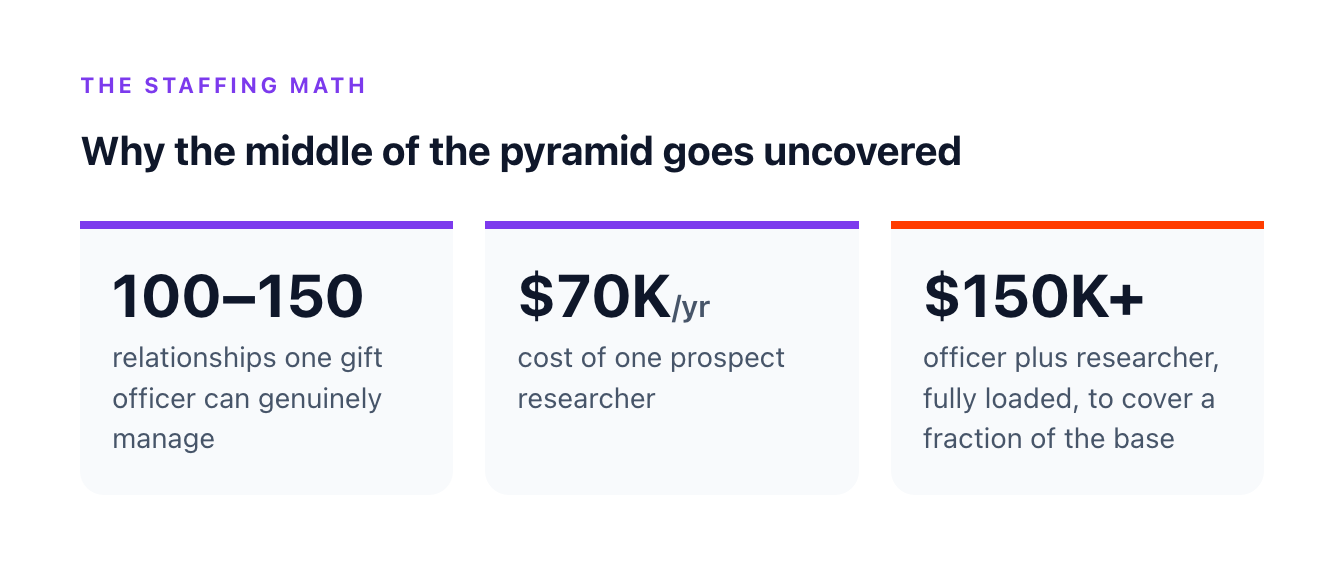
Advancement teams know all of this. The middle and bottom of the donor pyramid go uncultivated because of simple arithmetic. A gift officer can genuinely manage a portfolio of 100 to 150 relationships, so every officer hour naturally flows to the donors with the highest capacity, the same 2% who already carry the number.
Everyone else, the thousands of small and mid-level donors who are the future of the program, gets an annual fund appeal, a receipt, and maybe a newsletter. At lean shops with one to three officers, even that is a stretch.
And hiring out of the problem does not pencil: a prospect researcher runs roughly $70,000 a year, and a new gift officer plus a researcher can exceed $150,000 fully loaded, to cover a fraction of the base.
Reach the other 98% with the team you already have.
See how Risely’s advancement agent cultivates your full donor base without new headcount.
Book a DemoWhat do AI advancement agents actually change?
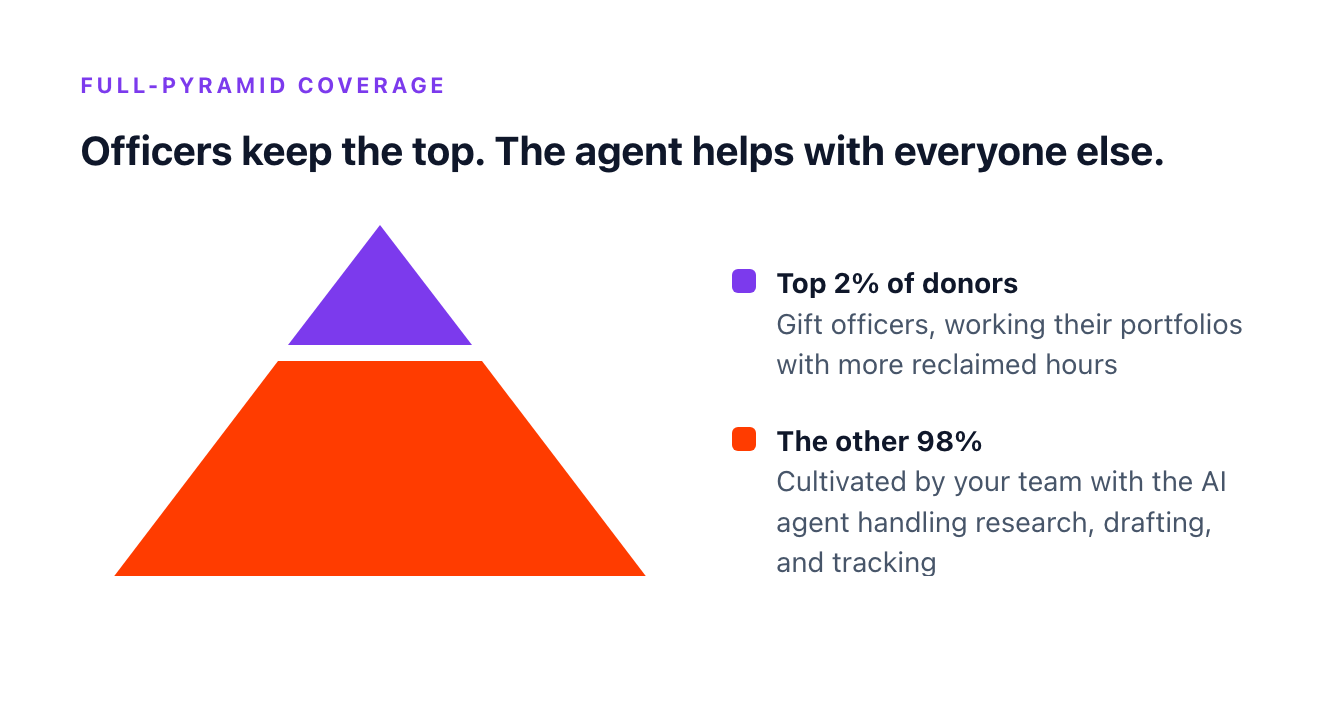
This is exactly the tier of the pyramid where AI advancement agents help. Gift officers keep working the top 2%, and the agent works alongside the rest of the team, handling the busywork of cultivation so staff can stay in front of thousands of donors they never had time to reach.
In practice, that means helping your team deliver:
- Personalized outreach: every donor hears from your team, grounded in their actual giving history
- Mid-level cultivation: consistent givers are identified and developed toward larger gifts instead of sitting unnoticed in the CRM
- Smarter campaign asks: each ask references the donor’s last gift and frames the next one around the campaign goal
- Lapse alerts: donors starting to slip, including major donors, are flagged while there is still time to re-engage
- Less busywork: research, data entry, drafting, and tracking come off officers’ plates, freeing their hours for relationships
Westmont College is already running this way. Their advancement shop is lean: six gift officers, one prospect researcher, and more than 60,000 alumni and parents, with each officer carrying 150 to 170 households. In twelve weeks with Risely, that single researcher produced 121 prospect briefs, and drafting a research framework went from about an hour to 66 seconds. The team gained 4× more capacity for strategic research with no new hires.
“The fact that I can use it when I see a gift come in and address that right away. That’s something I’ve always been wanting to be able to do and just never had the capacity to do as a one-person shop.”
Neil Di Maggio, Director of Advancement Research, Westmont College

Each of these touches compounds over time, creating donor relationships that deepen year after year. Reclaimed officer time flows back to the top of the pyramid, the team stays present across the middle and bottom, and the giving base gets steadily wider. The institution stops betting its future on 2% of its donors.
What should advancement teams do next?
Donors down, dollars up is also an opportunity. The middle of the pyramid is full of tomorrow’s major donors, and with the right tools, every one of them can finally get real attention. The institutions that keep cultivating the middle while everyone else chases the top will own the next decade of major gifts. And for the first time, doing that is possible with the staff you already have.
This is exactly what Risely’s advancement agent is built to do: it works alongside your team, engaging your entire donor base with personalized outreach, flagging donors who are starting to slip, and helping cultivate tomorrow’s major donors. Westmont College used it to 4× its prospect research capacity with the same team. Read the full case study.